Sodium Nitroprusside
Nipride · Nitropress
Direct arterial + venous vasodilator (NO donor)
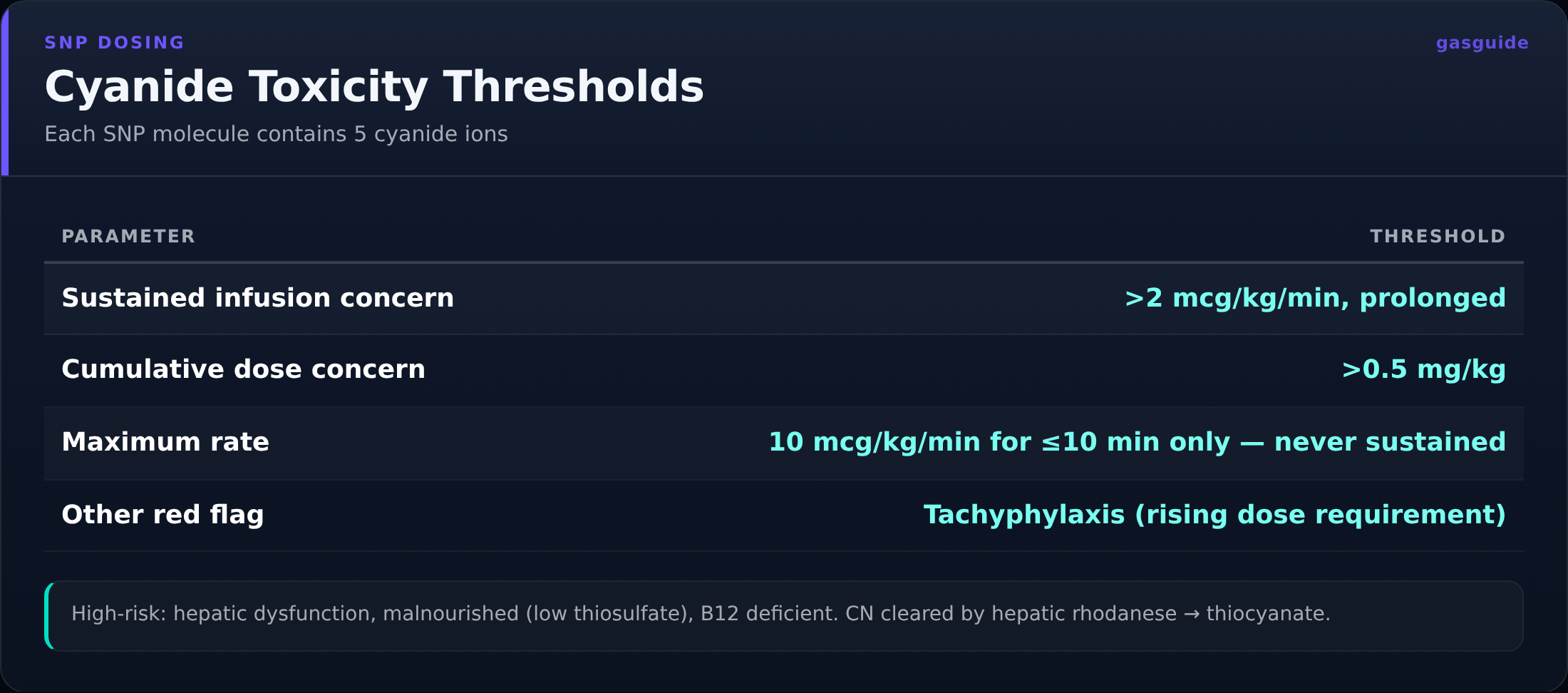
Spontaneously releases nitric oxide → ↑ cGMP → balanced arterial + venous dilation (↓ afterload AND preload). Each molecule contains 5 cyanide groups.
Indications
- •Hypertensive emergency
- •Controlled hypotension
- •Acute afterload reduction (acute MR/AR, aortic dissection with β-blocker)
Dosing
| Context | Adult | Pediatric |
|---|---|---|
| IV infusion | 0.3 mcg/kg/min, titrate (usual max 2–3; avoid >10 mcg/kg/min or prolonged high dose — cyanide) | — |
Pharmacokinetics
Onset seconds, offset 1–2 min → exquisitely titratable. Light-sensitive (wrap in foil). Metabolized to cyanide → thiocyanate (renal).
Hemodynamic effects
Rapid ↓ BP; reflex tachycardia; can cause coronary steal.
Respiratory effects
None directly.
Side effects
- !CYANIDE TOXICITY (↑ mixed-venous O₂, metabolic acidosis, tachyphylaxis, altered mental status — esp. high dose/prolonged/hepatic dysfunction)
- !Thiocyanate toxicity (renal failure, prolonged use)
- !Reflex tachycardia, coronary steal
- !↑ ICP (cerebral vasodilation)
- !Methemoglobinemia
Contraindications
- ×Compensatory hypertension (coarctation, AV shunt)
- ×Leber optic atrophy / tobacco amblyopia
- ×Severe hepatic (cyanide) or renal (thiocyanate) impairment
Reversal / antidote
Cyanide toxicity → stop infusion, 100% O₂, hydroxocobalamin (preferred) or sodium thiosulfate ± sodium nitrite
Clinical pearls
- ★CYANIDE is the signature toxicity — suspect it with tachyphylaxis (rising dose need), metabolic acidosis, and a HIGH mixed-venous O₂ sat (cells can't use O₂).
- ★Treat with hydroxocobalamin (or sodium thiosulfate); protect the infusion from light.
- ★Balanced arterial + venous dilation (contrast nitroglycerin, which is venous-predominant).
Other drugs in Cardiac / BP
- Epinephrine
α1 (vasoconstriction), α2, β1 (inotropy + chronotropy), β2 (bronchodilation, vasodilation in skeletal muscle). Dose-dependent receptor preference: low-dose β-predominant, high-dose α-predominant.
- Norepinephrine
Strong α1 → vasoconstriction. Mild β1 → modest inotropy. Minimal β2.
- Phenylephrine
Pure α1 agonist → vasoconstriction. No β activity.
- Dexmedetomidine
α2 agonist (locus coeruleus) → sedation + analgesia + anxiolysis without significant respiratory depression.
- Vasopressin
Endogenous nonapeptide hormone. V1 receptor agonist on vascular smooth muscle (Gq → IP3 → Ca²⁺ → vasoconstriction). V2 on renal collecting ducts (Gs → cAMP → aquaporin insertion → water reabsorption). At pressor doses (0.01–0.04 U/min), V1 effects dominate.
- Esmolol
Selective β1-adrenergic receptor antagonist. Decreases HR, contractility, conduction velocity, and AV node refractoriness. Selectivity for β1 over β2 reduces (does not eliminate) bronchospasm risk vs non-selective beta-blockers.
- Magnesium Sulfate
Multiple mechanisms: (1) NMDA receptor antagonism (anticonvulsant, analgesic); (2) Voltage-gated calcium channel blockade in vascular + uterine smooth muscle (vasodilation, tocolysis); (3) Decreased ACh release at neuromuscular junction (NMB potentiation); (4) Membrane stabilization (antiarrhythmic, especially torsades).
Suggested reading
- •Stoelting & Hines, Pharmacology & Physiology in Anesthetic Practice, 6e
- •Miller's Anesthesia, 9e
- •FDA package insert