Dopamine
Intropin
Endogenous catecholamine — dose-dependent inopressor
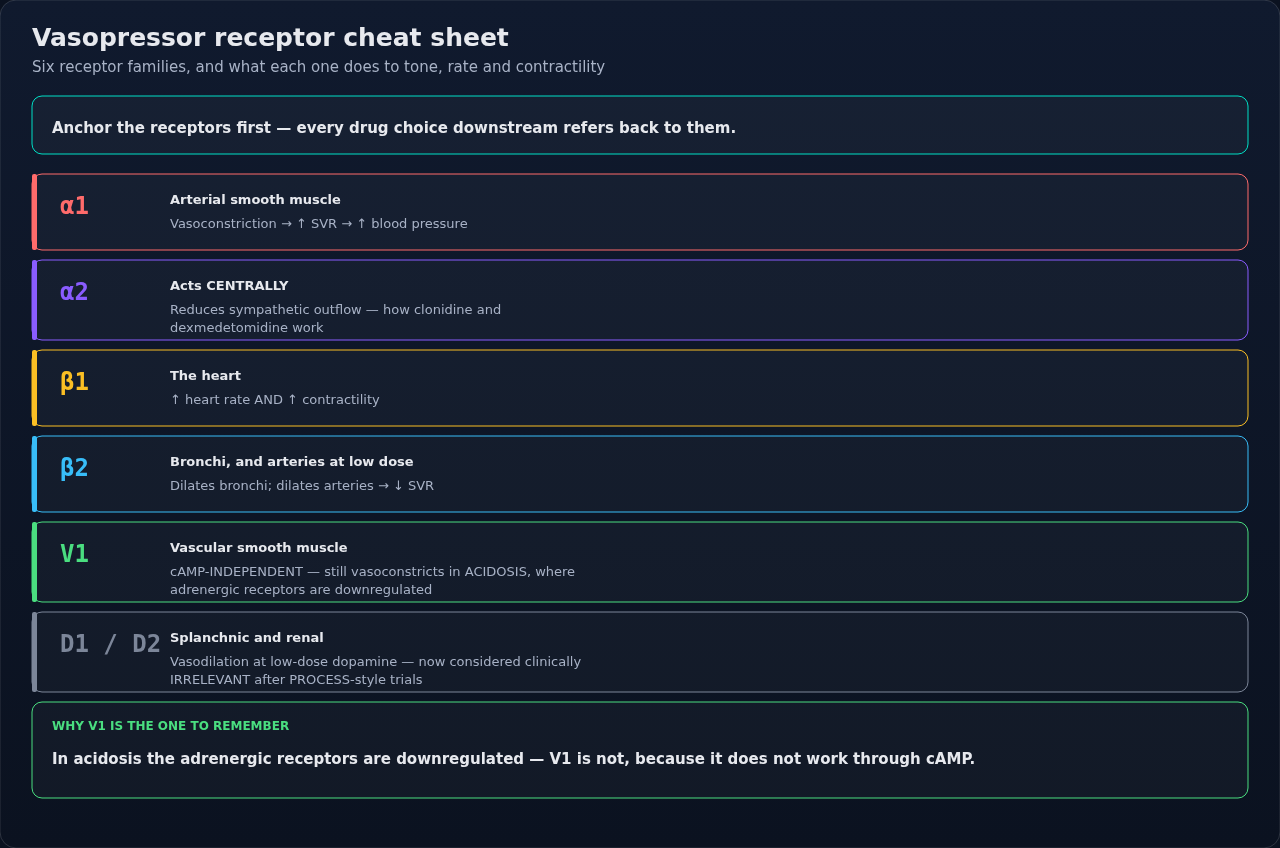
Dose-dependent receptor activation: low → dopaminergic (renal/splanchnic vasodilation); moderate → β1 (inotropy/chronotropy); high → α1 (vasoconstriction). Also releases norepinephrine.
Indications
- •Hypotension/shock with reduced cardiac output
- •Symptomatic bradycardia
- •(Historical) 'renal-dose' — no longer recommended)
Dosing
| Context | Adult | Pediatric |
|---|---|---|
| Renal/dopaminergic (obsolete) | 1–3 mcg/kg/min (does NOT protect kidneys — abandoned) | — |
| Inotropic (β1) | 3–10 mcg/kg/min | — |
| Vasopressor (α1) | >10 mcg/kg/min | — |
Pharmacokinetics
Onset <5 min. Half-life ~2 min. MAO/COMT metabolism. Central line preferred (extravasation → necrosis).
Hemodynamic effects
Tachycardia + arrhythmias more than norepinephrine at equivalent MAP; the reason NE is now first-line in septic shock (SOAP II — dopamine had more arrhythmias + higher mortality in cardiogenic shock).
Side effects
- !Tachyarrhythmias
- !Tissue necrosis on extravasation (treat with phentolamine)
- !↑ myocardial O2 demand
Contraindications
- ×Pheochromocytoma
- ×Uncorrected tachyarrhythmias
- ×Extravasation risk (peripheral)
Clinical pearls
- ★'Renal-dose dopamine' is a myth — it does not prevent AKI (abandoned).
- ★Norepinephrine has largely replaced it (fewer arrhythmias, better outcomes — SOAP II).
- ★Extravasation → local phentolamine.
Other drugs in Cardiac / BP
- Epinephrine
α1 (vasoconstriction), α2, β1 (inotropy + chronotropy), β2 (bronchodilation, vasodilation in skeletal muscle). Dose-dependent receptor preference: low-dose β-predominant, high-dose α-predominant.
- Norepinephrine
Strong α1 → vasoconstriction. Mild β1 → modest inotropy. Minimal β2.
- Phenylephrine
Pure α1 agonist → vasoconstriction. No β activity.
- Dexmedetomidine
α2 agonist (locus coeruleus) → sedation + analgesia + anxiolysis without significant respiratory depression.
- Vasopressin
Endogenous nonapeptide hormone. V1 receptor agonist on vascular smooth muscle (Gq → IP3 → Ca²⁺ → vasoconstriction). V2 on renal collecting ducts (Gs → cAMP → aquaporin insertion → water reabsorption). At pressor doses (0.01–0.04 U/min), V1 effects dominate.
- Esmolol
Selective β1-adrenergic receptor antagonist. Decreases HR, contractility, conduction velocity, and AV node refractoriness. Selectivity for β1 over β2 reduces (does not eliminate) bronchospasm risk vs non-selective beta-blockers.
- Magnesium Sulfate
Multiple mechanisms: (1) NMDA receptor antagonism (anticonvulsant, analgesic); (2) Voltage-gated calcium channel blockade in vascular + uterine smooth muscle (vasodilation, tocolysis); (3) Decreased ACh release at neuromuscular junction (NMB potentiation); (4) Membrane stabilization (antiarrhythmic, especially torsades).
- Amiodarone
Multichannel blockade — primarily class III (K+ channel block → prolonged repolarization, increased refractory period), plus class I (Na+ block), class II (β-blocker), class IV (Ca²⁺ block) properties. Treats most supraventricular AND ventricular arrhythmias. Long elimination half-life (weeks–months) limits chronic use.
Browse all classes: /reference/drugs
Suggested reading
- •Miller's Anesthesia, 9e
- •FDA package insert
- •AHA ACLS guidelines, 2020