Adenosine
Adenocard
Endogenous nucleoside antiarrhythmic (transient AV nodal block)
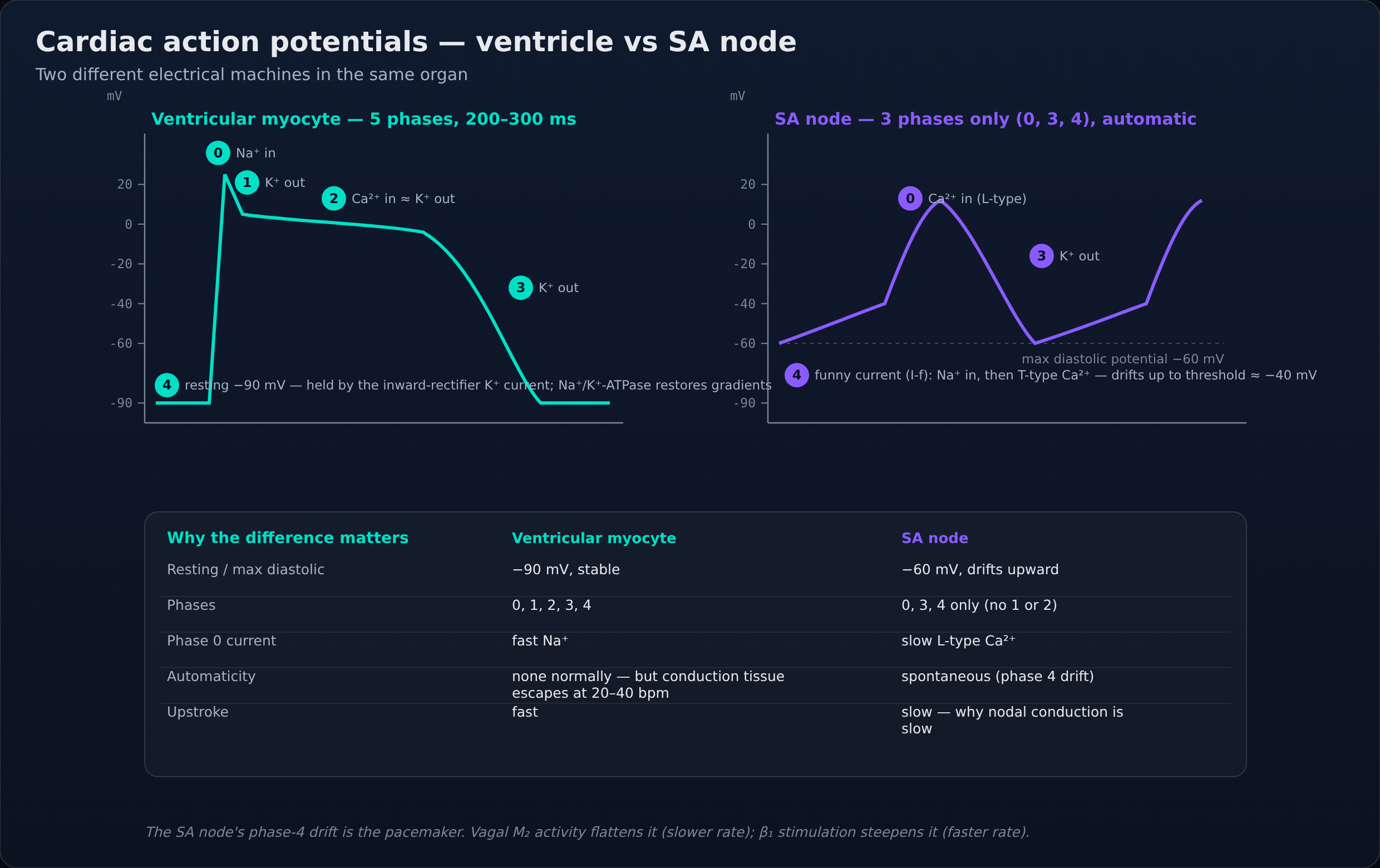
Activates A1 receptors → ↑ K⁺ efflux, ↓ Ca²⁺ current at the AV node → transient complete AV block. Terminates re-entrant SVT that uses the AV node.
Indications
- •Diagnosis + termination of AV-nodal-dependent SVT (AVNRT, AVRT)
- •Differentiating wide-complex tachycardias (with caution)
Dosing
| Context | Adult | Pediatric |
|---|---|---|
| SVT | 6 mg RAPID IV push + flush; if no effect 12 mg, may repeat 12 mg | 0.1 mg/kg (max 6), then 0.2 mg/kg (max 12) |
| Via central line / transplanted heart | Reduce dose (denervated heart is hypersensitive — start ~3 mg) | — |
Pharmacokinetics
Onset seconds. Half-life <10 sec (metabolized by RBC/endothelial adenosine deaminase) — MUST push fast + flush.
Hemodynamic effects
Transient asystole/pause is expected + diagnostic; brief flushing, chest tightness, dyspnea.
Side effects
- !Transient asystole (expected)
- !Flushing, chest pain, dyspnea, 'sense of doom'
- !Bronchospasm (asthma)
- !Can precipitate AF
Contraindications
- ×2nd/3rd-degree AV block or sick sinus (without pacer)
- ×Severe asthma
- ×WPW with pre-excited AF (won't help; use procainamide)
Clinical pearls
- ★Push as FAST as possible through the MOST proximal port + immediate saline flush — half-life <10 sec.
- ★Reduce dose in transplanted (denervated) hearts + central-line administration (hypersensitivity).
- ★Dipyridamole potentiates; theophylline/caffeine antagonize (may need higher dose).
Other drugs in Cardiac / BP
- Epinephrine
α1 (vasoconstriction), α2, β1 (inotropy + chronotropy), β2 (bronchodilation, vasodilation in skeletal muscle). Dose-dependent receptor preference: low-dose β-predominant, high-dose α-predominant.
- Norepinephrine
Strong α1 → vasoconstriction. Mild β1 → modest inotropy. Minimal β2.
- Phenylephrine
Pure α1 agonist → vasoconstriction. No β activity.
- Dexmedetomidine
α2 agonist (locus coeruleus) → sedation + analgesia + anxiolysis without significant respiratory depression.
- Vasopressin
Endogenous nonapeptide hormone. V1 receptor agonist on vascular smooth muscle (Gq → IP3 → Ca²⁺ → vasoconstriction). V2 on renal collecting ducts (Gs → cAMP → aquaporin insertion → water reabsorption). At pressor doses (0.01–0.04 U/min), V1 effects dominate.
- Esmolol
Selective β1-adrenergic receptor antagonist. Decreases HR, contractility, conduction velocity, and AV node refractoriness. Selectivity for β1 over β2 reduces (does not eliminate) bronchospasm risk vs non-selective beta-blockers.
- Magnesium Sulfate
Multiple mechanisms: (1) NMDA receptor antagonism (anticonvulsant, analgesic); (2) Voltage-gated calcium channel blockade in vascular + uterine smooth muscle (vasodilation, tocolysis); (3) Decreased ACh release at neuromuscular junction (NMB potentiation); (4) Membrane stabilization (antiarrhythmic, especially torsades).
- Amiodarone
Multichannel blockade — primarily class III (K+ channel block → prolonged repolarization, increased refractory period), plus class I (Na+ block), class II (β-blocker), class IV (Ca²⁺ block) properties. Treats most supraventricular AND ventricular arrhythmias. Long elimination half-life (weeks–months) limits chronic use.
Browse all classes: /reference/drugs
Suggested reading
- •Miller's Anesthesia, 9e
- •FDA package insert
- •AHA ACLS guidelines, 2020