Benzocaine
Cetacaine (component) · Hurricaine · Orajel
Ester local anesthetic (topical only)
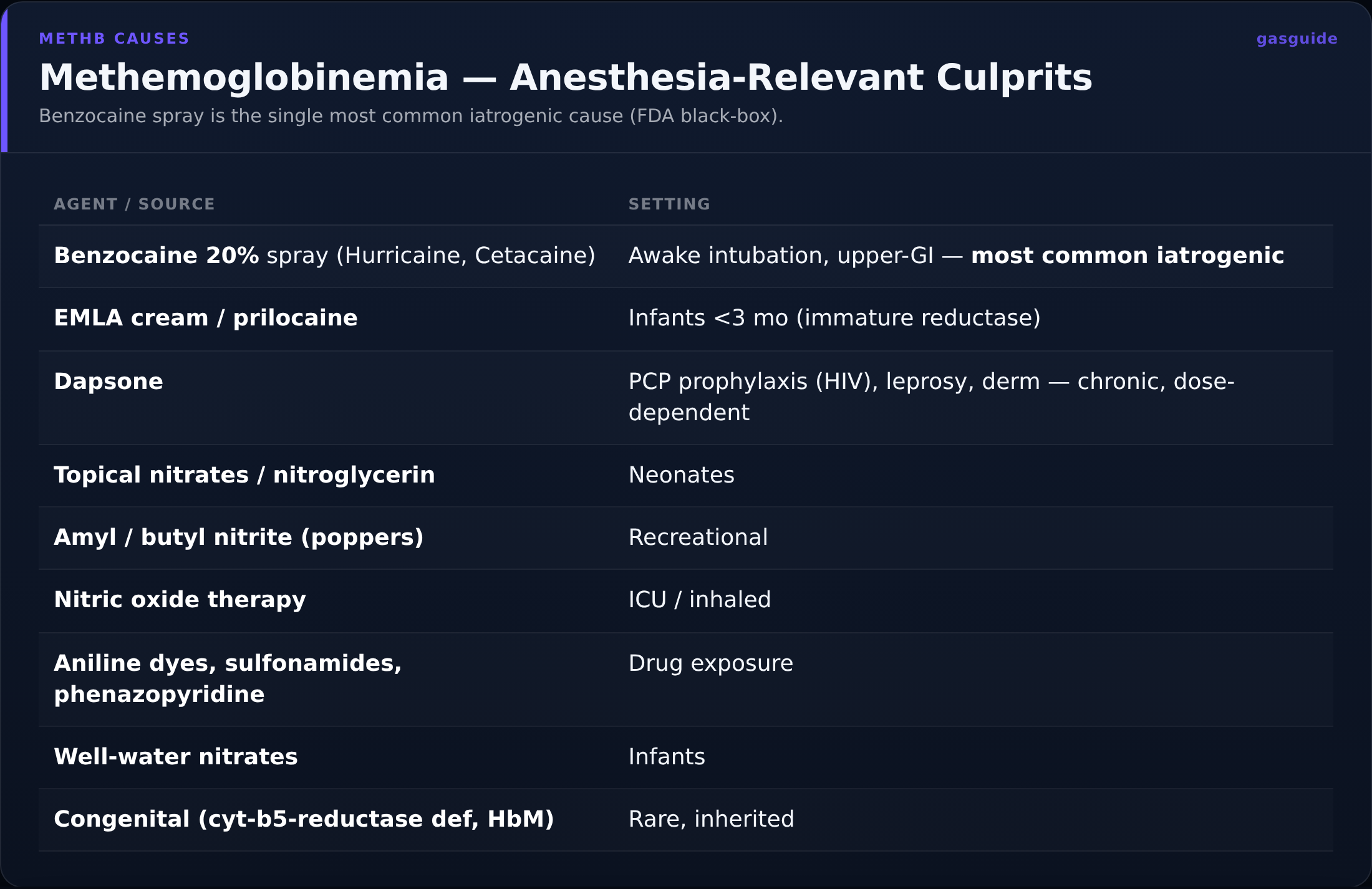
Na⁺-channel blocker; poorly water-soluble → topical use only. Classic cause of methemoglobinemia.
Indications
- •Topical mucosal anesthesia (airway, oropharynx, GI endoscopy)
Dosing
| Context | Adult | Pediatric |
|---|---|---|
| Topical spray | Brief single spray (<1 sec) — dose is hard to control; FDA warns re: methemoglobinemia | — |
Pharmacokinetics
Onset ~30 sec topical. Short duration.
Side effects
- !METHEMOGLOBINEMIA (a leading drug cause — even brief sprays)
- !Local irritation
Contraindications
- ×Infants <2 y (FDA warning)
- ×Methemoglobinemia risk / G6PD
Reversal / antidote
Methylene blue for symptomatic methemoglobinemia
Clinical pearls
- ★Notorious methemoglobinemia trigger — a single airway spray can cause it. Many centers have removed it.
- ★Saturation gap + chocolate-brown blood + SpO2 plateau ~85% → co-oximetry → methylene blue.
Other drugs in Local Anesthetics
- Lidocaine
Blocks voltage-gated Na⁺ channels in nerves (LA) and cardiac myocytes (antiarrhythmic).
- Bupivacaine
Voltage-gated Na⁺ channel blocker. Higher protein binding and lipid solubility than lidocaine → longer duration but greater cardiotoxicity.
- Ropivacaine
S-enantiomer of propivacaine. Less lipid-soluble than bupivacaine → less cardiotoxicity but slightly less potency.
- Tetracaine
Blocks voltage-gated Na⁺ channels. Long-acting ester, metabolized by plasma cholinesterase. High potency + toxicity.
- Chloroprocaine
Na⁺-channel blocker. Extremely rapid plasma-cholinesterase metabolism (half-life seconds) → lowest systemic toxicity of the LAs, ideal for OB epidural top-up.
- Procaine
Na⁺-channel blocker; prototype ester LA. Plasma-cholinesterase metabolized to PABA.
- Prilocaine
Na⁺-channel blocker. Metabolized to o-toluidine → oxidizes hemoglobin → methemoglobinemia at high doses.
- Levobupivacaine
The S(−)-enantiomer of bupivacaine → similar block with LESS cardiotoxicity + CNS toxicity than racemic bupivacaine.
Browse all classes: /reference/drugs
Suggested reading
- •Stoelting & Hines, Pharmacology & Physiology in Anesthetic Practice, 6e
- •FDA package insert
- •ASRA LAST checklist, 2020