Bupivacaine
Marcaine · Sensorcaine
Amide local anesthetic, long-acting
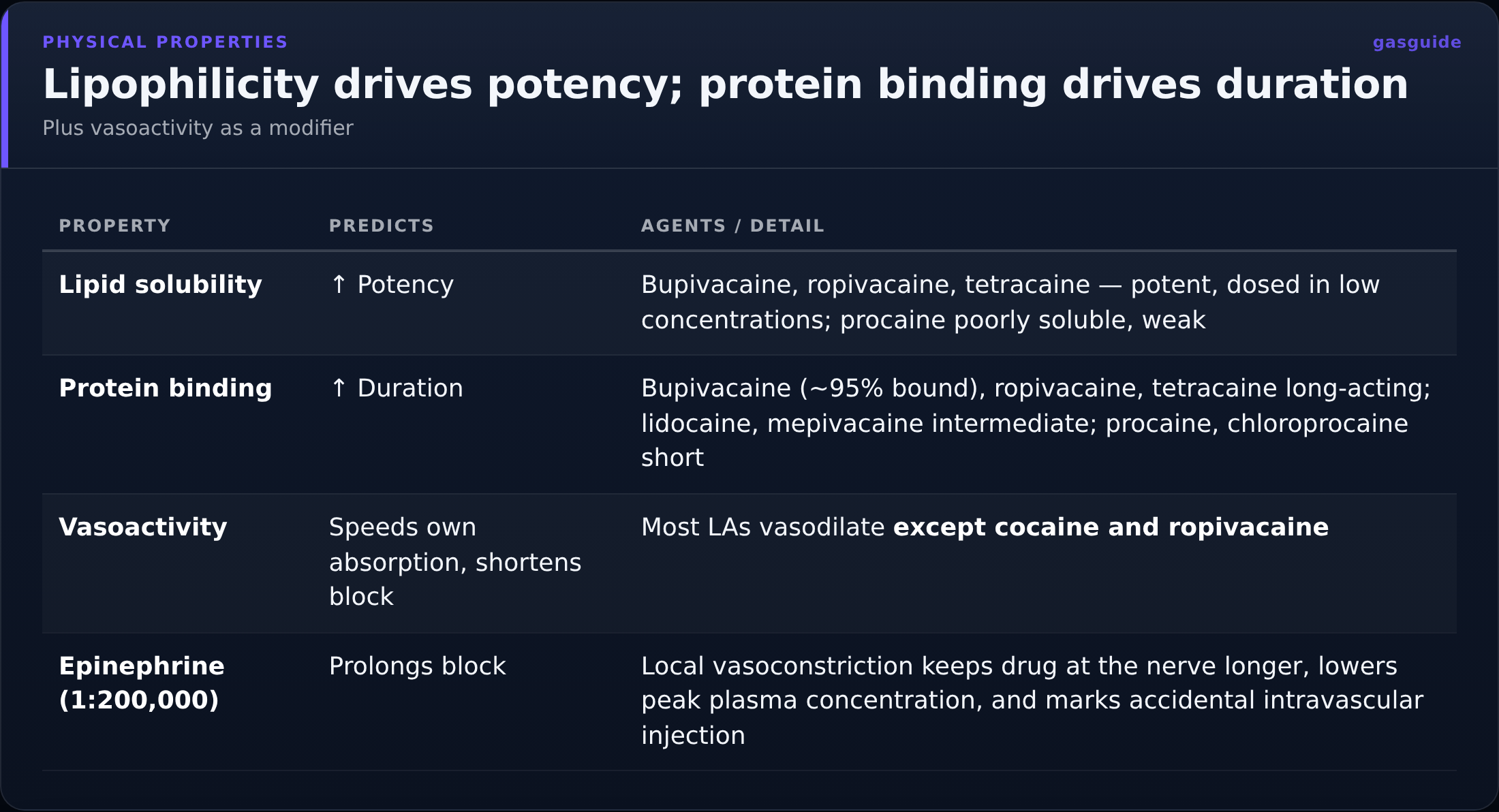
Voltage-gated Na⁺ channel blocker. Higher protein binding and lipid solubility than lidocaine → longer duration but greater cardiotoxicity.
Indications
- •Spinal/epidural
- •Peripheral nerve blocks
- •Wound infiltration
Dosing
| Context | Adult | Pediatric |
|---|---|---|
| Local infiltration | Max 2.5 mg/kg plain; 3 mg/kg with epi | — |
| Spinal anesthesia | 0.5% hyperbaric 7.5–15 mg | — |
| Epidural | 0.25–0.5% 10–20 mL bolus, 0.0625–0.125% 4–10 mL/hr infusion | — |
| Peripheral block | 0.25–0.5% 20–40 mL | — |
Maximum dose
2.5 mg/kg plain (absolute max 175 mg) · 3 mg/kg with epi (absolute max 225 mg)
Max-dose calculator
single-injection infiltration / blockPlain
175 mg
With epinephrine
210 mg
| Concentration | Max volume (plain) | Max volume (with epi) |
|---|---|---|
| 0.25% (2.5 mg/mL) | 70 mL | 84 mL |
| 0.5% (5 mg/mL) | 35 mL | 42 mL |
| 0.75% (7.5 mg/mL) | 23.3 mL | 28 mL |
Most cardiotoxic LA — aspirate, dose incrementally, never IV/Bier block. Education only — confirm against the package insert. Max doses are not additive across agents; account for total LA when mixing.
Pharmacokinetics
Onset 5–15 min. Duration 4–8 h. Hepatic CYP3A4.
Side effects
- !LAST — bupivacaine more cardiotoxic than equipotent lidocaine; ventricular arrhythmias dominate over CNS prodrome
- !TNS rare (vs. lidocaine)
- !Maternal hypotension after spinal (sympathectomy)
Contraindications
- ×IV regional anesthesia (use lidocaine)
- ×Bier block — never bupivacaine
Reversal / antidote
If LAST: lipid emulsion 20% 1.5 mL/kg bolus + 0.25 mL/kg/min infusion. Modified ACLS (low-dose epi).
Clinical pearls
- ★Liposomal bupivacaine (Exparel) — single-injection 24–72 h analgesia for surgical infiltration / TAP / interscalene.
- ★Avoid mixing with lidocaine in same syringe — pharmacokinetics unpredictable.
- ★Lipid rescue more for bupi than ropi or lidocaine.
Other drugs in Local Anesthetics
- Lidocaine
Blocks voltage-gated Na⁺ channels in nerves (LA) and cardiac myocytes (antiarrhythmic).
- Ropivacaine
S-enantiomer of propivacaine. Less lipid-soluble than bupivacaine → less cardiotoxicity but slightly less potency.
- Tetracaine
Blocks voltage-gated Na⁺ channels. Long-acting ester, metabolized by plasma cholinesterase. High potency + toxicity.
- Chloroprocaine
Na⁺-channel blocker. Extremely rapid plasma-cholinesterase metabolism (half-life seconds) → lowest systemic toxicity of the LAs, ideal for OB epidural top-up.
- Procaine
Na⁺-channel blocker; prototype ester LA. Plasma-cholinesterase metabolized to PABA.
- Prilocaine
Na⁺-channel blocker. Metabolized to o-toluidine → oxidizes hemoglobin → methemoglobinemia at high doses.
- Levobupivacaine
The S(−)-enantiomer of bupivacaine → similar block with LESS cardiotoxicity + CNS toxicity than racemic bupivacaine.
- Articaine
Amide LA that uniquely also has a thiophene ester group → partial plasma-esterase metabolism → shorter systemic half-life. Excellent bone/tissue penetration in dentistry.
Browse all classes: /reference/drugs
Suggested reading
- •Stoelting & Hines, Pharmacology & Physiology in Anesthetic Practice, 6e
- •FDA package insert
- •ASRA LAST checklist, 2020