Methohexital
Brevital
Oxybarbiturate IV induction agent (short-acting)
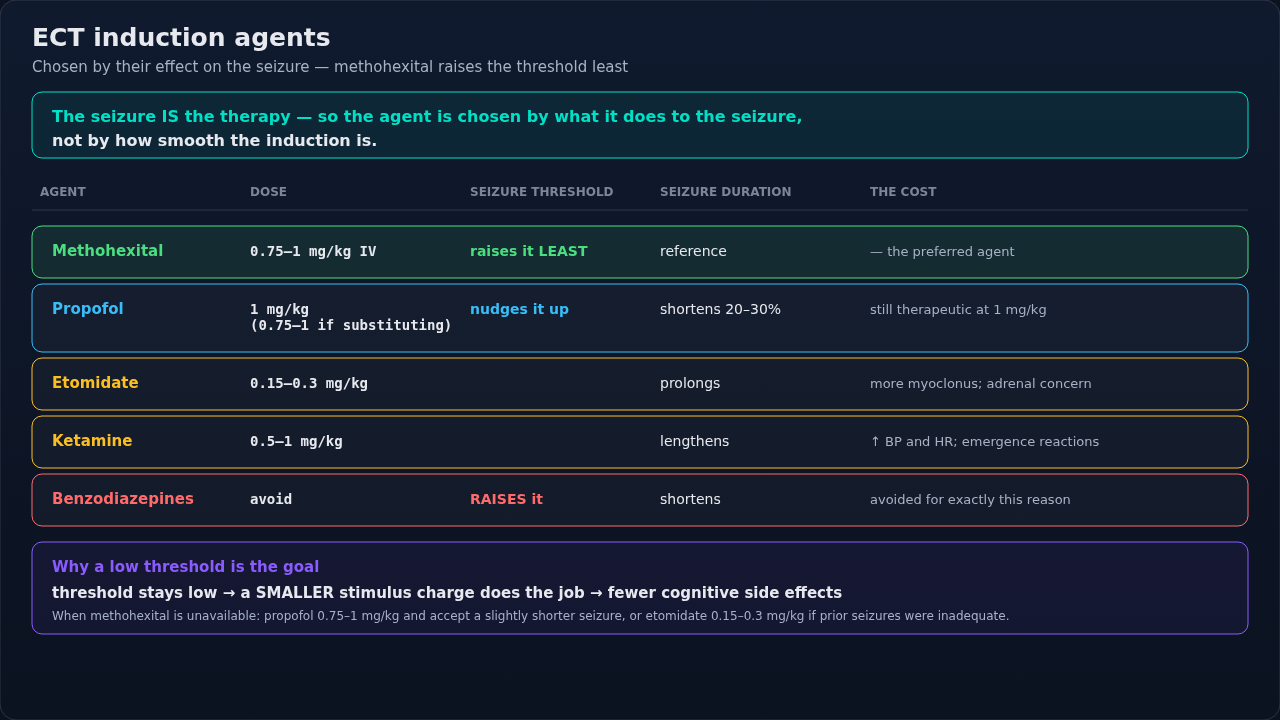
GABA-A potentiation. Shorter-acting than thiopental; lowers seizure threshold (useful for ECT).
Indications
- •ECT (induction of choice — promotes seizure)
- •Brief procedural anesthesia
- •Pediatric rectal induction (historical)
Dosing
| Context | Adult | Pediatric |
|---|---|---|
| Induction | 1–1.5 mg/kg IV | — |
| ECT | 0.5–1 mg/kg IV | — |
Pharmacokinetics
Onset ~30 sec. Duration ~5–10 min (redistribution). Hepatic metabolism faster than thiopental.
Hemodynamic effects
↓ BP, tachycardia (less than thiopental at equipotent doses).
Respiratory effects
Dose-dependent respiratory depression.
Side effects
- !Myoclonus, hiccups
- !Pain on injection
- !LOWERS seizure threshold
- !Porphyria trigger
Contraindications
- ×Acute porphyria
- ×Seizure disorder (relative — except intentional ECT use)
Clinical pearls
- ★Induction agent of choice for ECT — minimal anticonvulsant effect (may even lower the seizure threshold), preserving seizure quality, unlike propofol which shortens seizures.
- ★Also a barbiturate → contraindicated in acute porphyria.
Other drugs in Induction Agents
- Propofol
Potentiates GABA-A chloride conductance. Direct CNS depression with no analgesia.
- Etomidate
GABA-A potentiation. Highly hemodynamically stable due to minimal SVR/contractility effects.
- Ketamine
Non-competitive NMDA receptor antagonist. Also effects on opioid, monoaminergic, muscarinic receptors. Produces dissociative anesthesia with analgesia.
- Thiopental
Enhances GABA-A chloride currents (↑ channel-open duration) → rapid loss of consciousness. Classic barbiturate induction agent.
- Remimazolam
GABA-A benzodiazepine agonist with an ester linkage → rapid hydrolysis by tissue esterases (like remifentanil among opioids) → fast recovery, organ-independent.
Browse all classes: /reference/drugs
Suggested reading
- •Stoelting & Hines, Pharmacology & Physiology in Anesthetic Practice, 6e
- •Miller's Anesthesia, 9e
- •FDA package insert