Potassium Chloride
KCl · K-Dur · Klor-Con
Potassium salt for replacement therapy
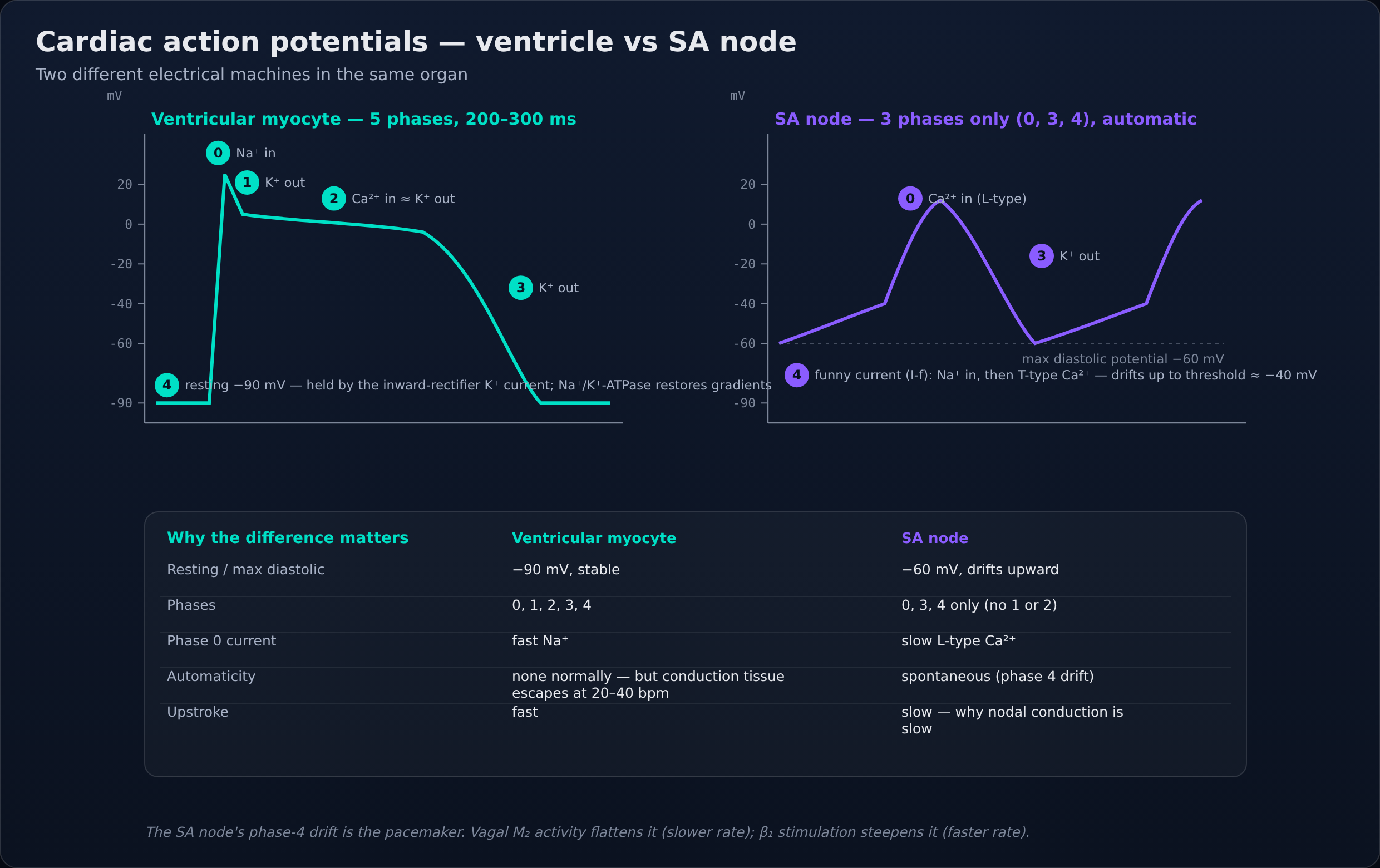
Provides K⁺ for replacement of intracellular and serum stores. Maintains resting membrane potential. 1 mEq KCl = 39 mg potassium.
Indications
- •Hypokalemia (acute, chronic, drug-induced)
- •Maintenance K replacement in patients on diuretics
- •Replacement during DKA insulin therapy (drives K intracellular)
Dosing
| Context | Adult | Pediatric |
|---|---|---|
| Acute IV severe (K <3.0) | 10–20 mEq/h IV via central line, with continuous ECG; max 40 mEq/h via central with strong indication | — |
| Acute IV peripheral | 10 mEq/h max, concentration ≤10 mEq/100 mL | — |
| Mild oral | 20–60 mEq PO daily divided | — |
| DKA prophylactic replacement | 20–40 mEq/L in IV fluid as long as K <5.3 | — |
Pharmacokinetics
PO peak 1–2 h. IV effect immediate but redistribution into cells takes hours. Renal excretion (≥90%).
Hemodynamic effects
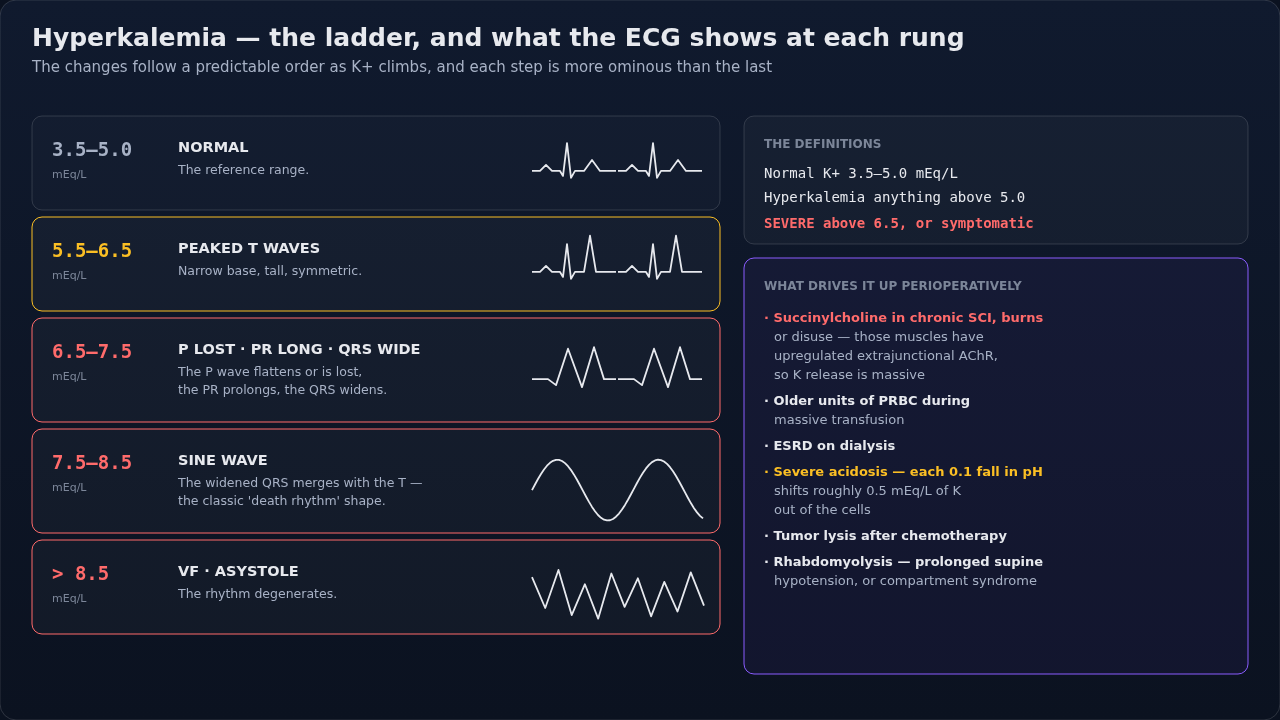
Excess serum K⁺ → cardiac arrhythmias up to and including asystole.
Respiratory effects
None directly.
Side effects
- !Cardiac arrhythmias from too-rapid administration or overshoot (peaked T waves, widened QRS, sine wave, asystole)
- !Phlebitis with peripheral lines (always dilute)
- !GI upset / ulceration with extended-release oral
Contraindications
- ×Hyperkalemia
- ×Untreated Addison's disease
- ×Severe oliguric renal failure
Clinical pearls
- ★NEVER IV PUSH: 'KCl IV push' has killed patients; sentinel-event in nursing/pharmacy literature. Always dilute and infuse with continuous ECG.
- ★PERIPHERAL LIMIT: 10 mEq/h, ≤10 mEq/100 mL concentration — beyond this, central line.
- ★MAGNESIUM PARTNER: refractory hypokalemia almost always co-exists with hypomagnesemia — replace both. Mag deficiency causes urinary K wasting.
- ★DKA RULES (ADA): K <3.3 → hold insulin, replace K first, restart insulin once K >3.3; K 3.3–5.3 → start insulin + replace 20–30 mEq/L in fluid; K >5.3 → start insulin without K replacement.
Other drugs in Electrolytes
- Calcium Chloride
Replaces ionized calcium → restores cardiac contractility, smooth muscle tone, neuromuscular function. Stabilizes cardiac myocyte membrane in hyperK by raising threshold potential.
- Calcium Gluconate
Provides elemental calcium (1 g calcium gluconate = ~93 mg / 4.65 mEq elemental Ca²⁺). One-third the elemental calcium of an equivalent dose of CaCl2 (1 g = 273 mg / 13.6 mEq). Used to treat hypocalcemia, antagonize cardiac membrane effects of hyperkalemia, magnesium toxicity, calcium-channel-blocker overdose.
- Sodium Bicarbonate
Provides bicarbonate → buffers H⁺ → raises serum + urine pH. Also drives K⁺ intracellularly.
- Sodium Citrate (Bicitra)
Citrate is metabolized to bicarbonate → neutralizes gastric acid. NON-PARTICULATE → if aspirated, far less lung injury than particulate antacids.
Browse all classes: /reference/drugs
Suggested reading
- •Miller's Anesthesia, 9e
- •FDA package insert