Calcium Gluconate
Calcium salt — peripheral-line-safe alternative to CaCl2
Provides elemental calcium (1 g calcium gluconate = ~93 mg / 4.65 mEq elemental Ca²⁺). One-third the elemental calcium of an equivalent dose of CaCl2 (1 g = 273 mg / 13.6 mEq). Used to treat hypocalcemia, antagonize cardiac membrane effects of hyperkalemia, magnesium toxicity, calcium-channel-blocker overdose.
Indications
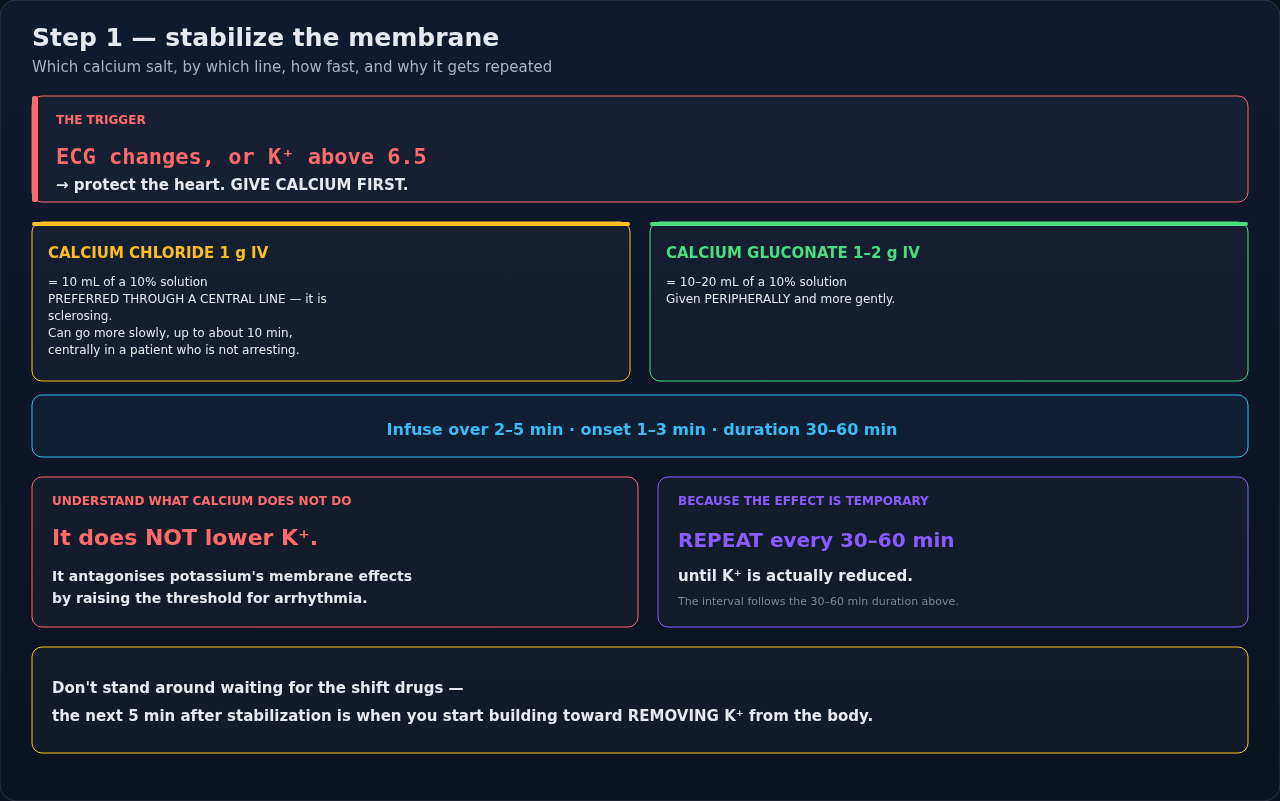
- •Hyperkalemia with ECG changes (membrane stabilization)
- •Hypocalcemic tetany / seizures
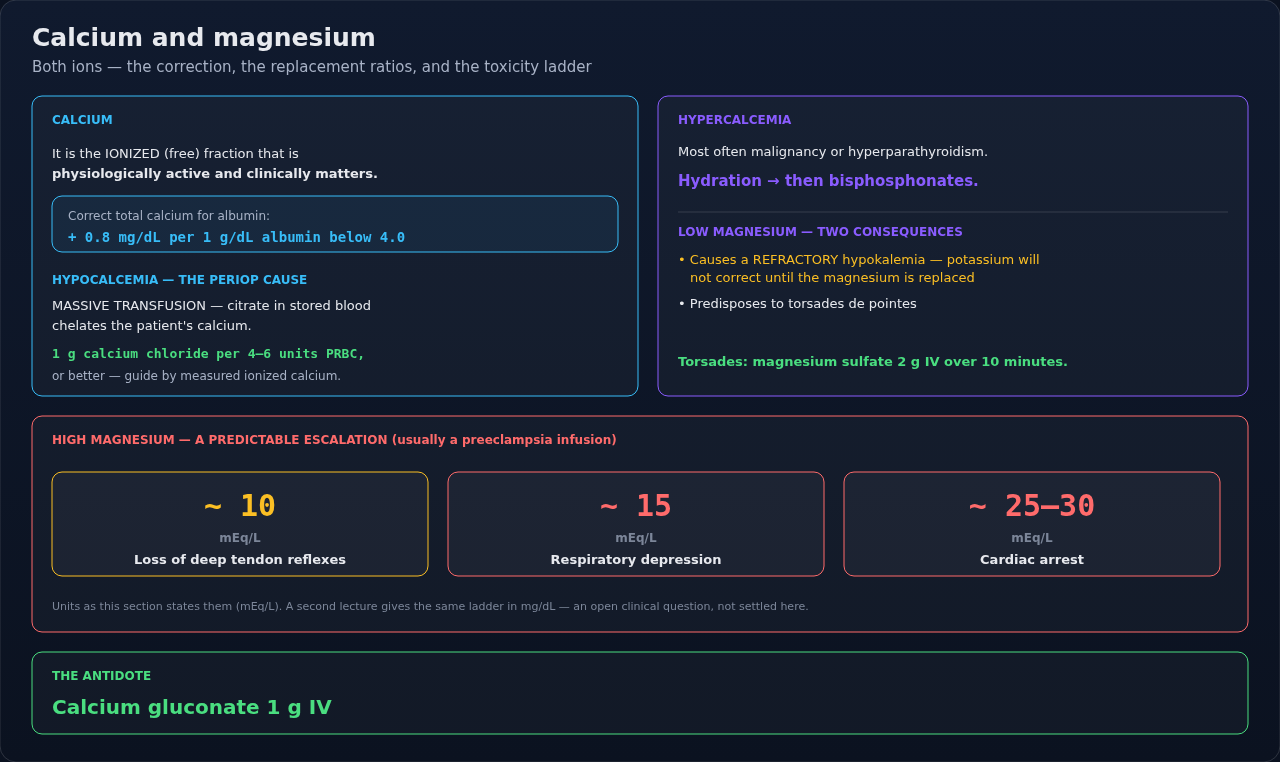
- •Massive transfusion with citrate-induced hypocalcemia
- •Magnesium-sulfate toxicity (preeclampsia)
- •Calcium-channel-blocker / β-blocker overdose
- •Hydrofluoric-acid burn
Dosing
| Context | Adult | Pediatric |
|---|---|---|
| Hyperkalemia | 1–2 g (10–20 mL of 10% solution) IV over 5 min; redose if no ECG change in 5 min | — |
| Hypocalcemia | 1–2 g IV over 10 min; recheck Ca²⁺ level | — |
| Mag toxicity | 1 g IV over 5–10 min | — |
| Massive transfusion | 1 g per 4 units PRBC empirically; better — measure ionized Ca²⁺ | — |
Pharmacokinetics
Onset 1 min IV. Duration 30–60 min on serum Ca²⁺. Renal excretion.
Hemodynamic effects
Mild positive inotropy + transient ↑BP. Bradycardia possible with rapid push.
Respiratory effects
None directly.
Side effects
- !Tissue necrosis with extravasation — less severe than CaCl2 but still a concern
- !Bradycardia, asystole with rapid push
- !Hypercalcemia (overshoot)
- !Worsens digoxin toxicity (theoretical 'stone heart' — modern data softer)
Contraindications
- ×Hypercalcemia
- ×Concomitant ceftriaxone (precipitation in lung/kidney — fatal in neonates; FDA warning 2007)
Clinical pearls
- ★PERIPHERAL LINE: gluconate is the peripheral-safe form. CaCl2 (3× the elemental calcium per gram) requires central access in most institutions — extravasation causes necrosis.
- ★MEMBRANE STABILIZATION IN HYPERK: gluconate works just as fast as CaCl2 — 1 min onset. The 3× elemental difference matters for repeated dosing, not the first push.
- ★CITRATE-INDUCED HYPO Ca²⁺ IN MASSIVE TRANSFUSION: 1 g for every 4 units PRBC empirically; better — measure ionized Ca²⁺ q30 min during MTP.
- ★DIGOXIN: 2010s observational data suggest the 'stone heart' risk was overstated. Use cautiously, give slowly.
Other drugs in Electrolytes
- Calcium Chloride
Replaces ionized calcium → restores cardiac contractility, smooth muscle tone, neuromuscular function. Stabilizes cardiac myocyte membrane in hyperK by raising threshold potential.
- Potassium Chloride
Provides K⁺ for replacement of intracellular and serum stores. Maintains resting membrane potential. 1 mEq KCl = 39 mg potassium.
- Sodium Bicarbonate
Provides bicarbonate → buffers H⁺ → raises serum + urine pH. Also drives K⁺ intracellularly.
- Sodium Citrate (Bicitra)
Citrate is metabolized to bicarbonate → neutralizes gastric acid. NON-PARTICULATE → if aspirated, far less lung injury than particulate antacids.
Browse all classes: /reference/drugs
Suggested reading
- •Miller's Anesthesia, 9e
- •FDA package insert