OR Cardiac Arrest
ACLS adapted for the operating room: anesthetic depth, surgical bleeding/positioning/embolism are reversible causes the medicine code team won't think of first.
⚡ Rehearsal mode
Walk the algorithm step by step
8 steps · click-through one at a time. Forces you to pre-read each action before moving on — the way you should rehearse the real thing.
Recognition
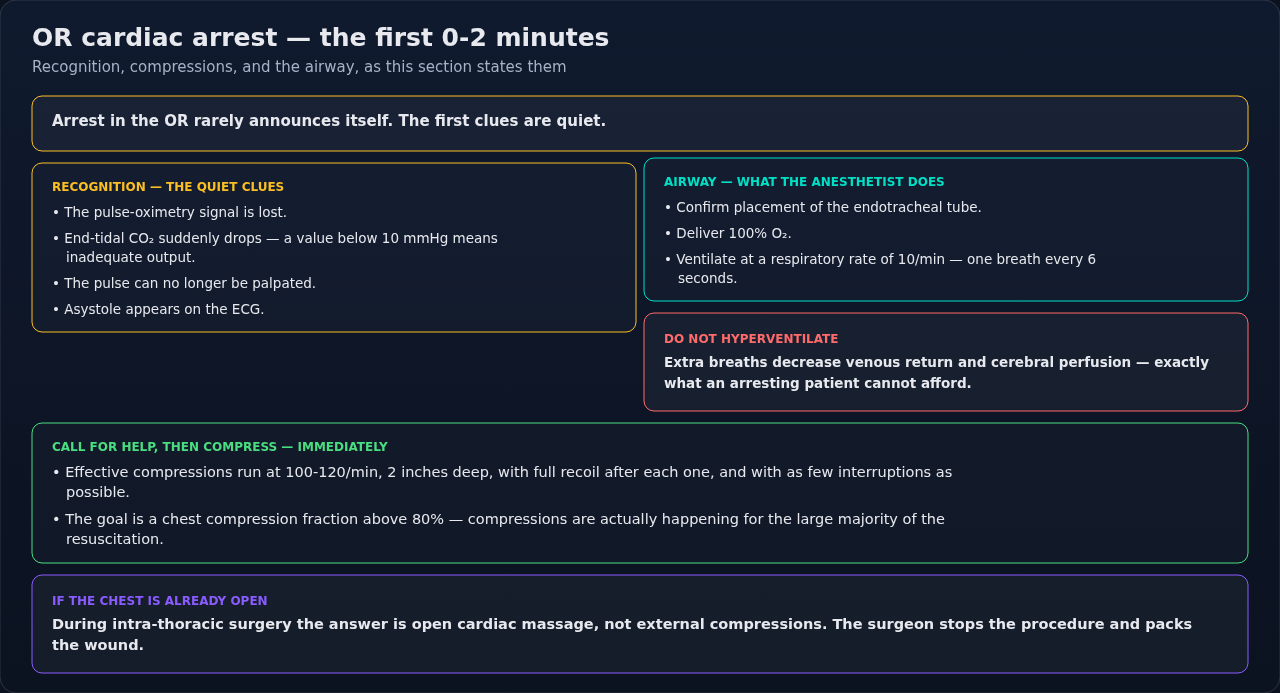
- •Loss of pulse on art line / pulse ox / ETCO₂ drop
- •Asystole, PEA, V-fib/V-tach on monitor
- •Sudden bradycardia → arrest in MH, LAST, sympathectomy
Steps
- 1Call code, start CPR (100–120/min, depth 5 cm), 100% O₂
- 2Reduce/stop volatile + vasodilatorsAnesthetic depth is a uniquely OR cause.
- 3Surgical pause + control hemorrhageSurgeon should pack + apply pressure; turn off insufflation.
- 4Reposition supine + LUD if pregnantProne CPR is feasible if access prevents repositioning.
- 5Standard ACLS drugs at standard doses (except LAST + bupivacaine)
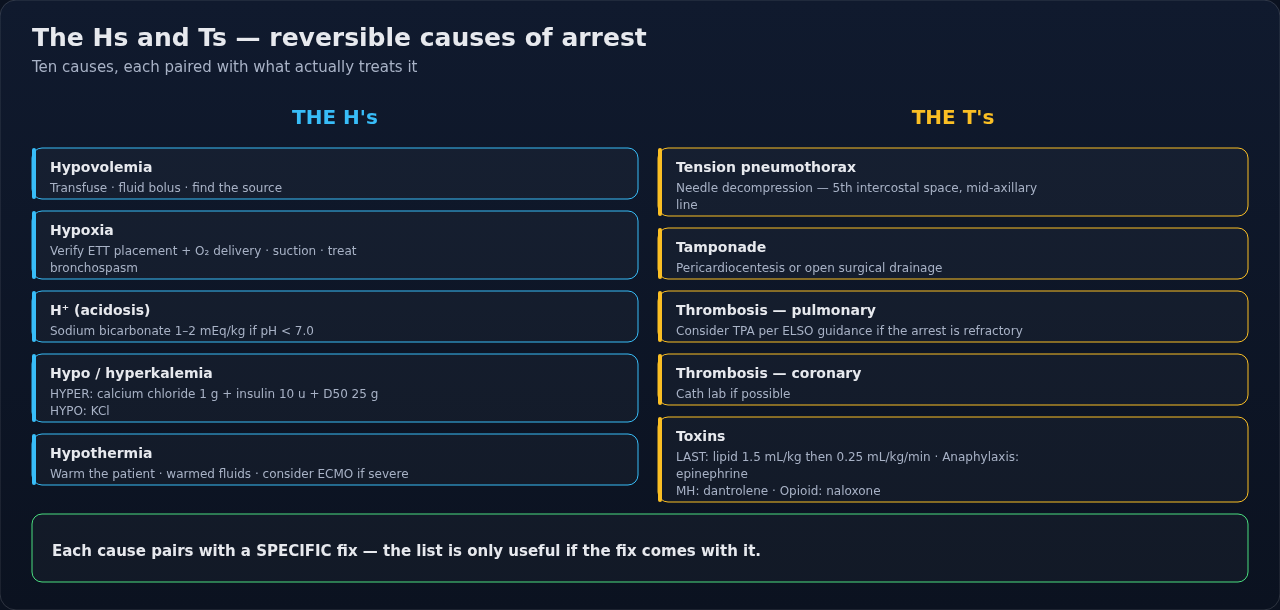
- 6Reverse causes — Hs/Ts + OR-specificHypovolemia, hypoxia, H⁺ acidosis, hypo/hyperkalemia, hypothermia, tension pneumo, tamponade, toxins (anaphylaxis, MH, LAST), thrombosis (PE/MI), trauma.
- 7TEE if available for cause + monitoring response
- 8Consider ECMO if refractory + reversible cause
Drugs + doses
| Drug | Dose | Note |
|---|---|---|
| Epinephrine | 1 mg IV q3–5 min (standard; ≤100 mcg in LAST) | |
| Amiodarone | 300 mg IV bolus, then 150 mg | |
| Calcium chloride | 1 g IV (hyperkalemia, CCB toxicity) | |
| Bicarb | 1 mEq/kg (severe acidosis, hyperkalemia, TCA OD) |
Pitfalls
- !If patient was just induced — anesthetic depth is the cause until proven otherwise.
- !Code team will not know about the surgical site; you must direct.
- !EtCO₂ < 10 during CPR predicts poor outcome — push harder, give vasopressor.
Suggested reading
- AHA ACLS 2020 Update
- Moitra Anesth Analg 2018
- Society Cardiothoracic Anesthesia Cardiac Arrest
Other crisis algorithms
- Malignant Hyperthermia (MH)
Hypermetabolic crisis triggered by volatile anesthetics or succinylcholine in genetically susceptible patients (RYR1, CACNA1S). Treat with dantrolene immediately.
- Perioperative Anaphylaxis
IgE-mediated (or pseudo-allergic) hemodynamic collapse from drug, latex, or transfusion exposure. Most common triggers in OR: NMBAs (rocuronium, succinylcholine), antibiotics, latex.
- Amniotic Fluid Embolism (AFE)
Rare, often fatal obstetric emergency — anaphylactoid syndrome of pregnancy. Sudden hemodynamic collapse, hypoxemia, and DIC during labor, delivery, or postpartum (within 30 min).
- LAST (Local Anesthetic Systemic Toxicity)
Cardiovascular and CNS toxicity from inadvertent IV injection or systemic absorption of local anesthetic. Bupivacaine highest cardiotoxicity. Ropivacaine + lidocaine slightly safer.
- Laryngospasm
Reflex closure of the vocal cords from light-anesthesia airway stimulation. Common in pediatrics, recent URI, and emergence. Untreated → hypoxia → bradycardia → arrest.
- High / Total Spinal
Cephalad spread of neuraxial local anesthetic causing apnea + cardiovascular collapse. Most common with epidural-to-subarachnoid migration in OB.