Malignant Hyperthermia (MH)
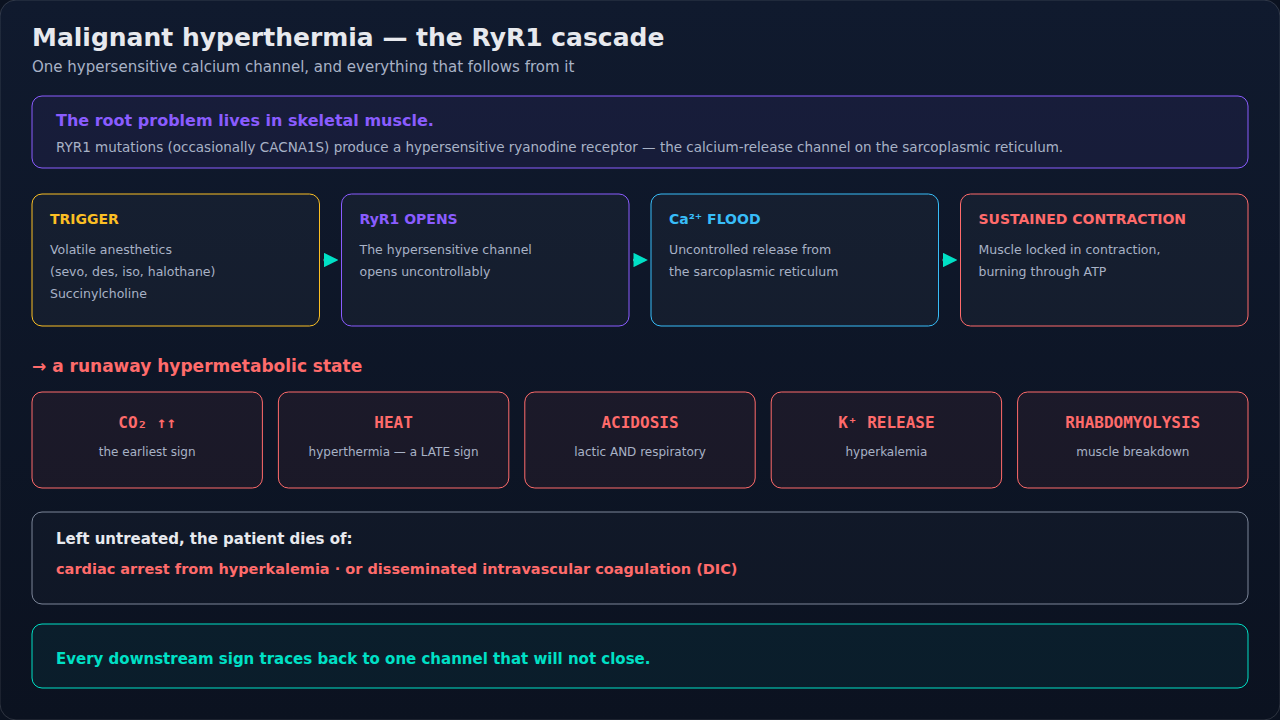
Hypermetabolic crisis triggered by volatile anesthetics or succinylcholine in genetically susceptible patients (RYR1, CACNA1S). Treat with dantrolene immediately.
⚡ Rehearsal mode
Walk the algorithm step by step
8 steps · click-through one at a time. Forces you to pre-read each action before moving on — the way you should rehearse the real thing.
Recognition
- •Unexplained ↑EtCO₂ unresponsive to ↑MV (often the earliest sign)
- •Tachycardia, tachypnea, masseter rigidity after sux
- •Mixed acidosis on ABG (respiratory + metabolic)
- •Late: hyperthermia (a late sign — do not wait for it)
- •Hyperkalemia, myoglobinuria, peaked T waves
Steps
- 1Call for help + MH cart + MHAUS hotline1-800-MH-HYPER (1-800-644-9737)
- 2Stop all triggersDiscontinue volatile + sux. Switch to TIVA (propofol).
- 3Hyperventilate 100% O₂ at ≥10 L/minFlush circuit; do not change machine if delays ventilation.
- 4Dantrolene 2.5 mg/kg IV bolusRepeat q5 min until symptoms resolve. Max ~10 mg/kg, often more.
- 5Active coolingIce packs to groin/axilla, cold IV NS, gastric/bladder lavage. Stop at 38°C.
- 6Treat hyperkalemia + arrhythmiasCalcium, insulin/dextrose, bicarb. Avoid CCBs (interaction with dantrolene).
- 7Foley + alkalinize urineBicarb + furosemide; goal UOP > 2 mL/kg/hr to prevent ARF from myoglobin.
- 8ICU x 24+ h, refer for genetic counseling
Drugs + doses
| Drug | Dose | Note |
|---|---|---|
| Dantrolene (Ryanodex preferred) | 2.5 mg/kg IV, repeat q5 min | Ryanodex 250 mg/vial reconstitutes in 5 mL — fast. Standard dantrolene 20 mg/vial in 60 mL water — slow. |
| Sodium bicarbonate | 1–2 mEq/kg titrated to ABG | |
| Calcium chloride | 10 mg/kg IV for hyperkalemia | |
| Insulin + D50 | 10 U regular insulin + 25 g dextrose | |
| Furosemide | 0.5–1 mg/kg IV |
Pitfalls
- !Calcium channel blockers + dantrolene → severe hyperkalemia. Avoid.
- !Mannitol is in the dantrolene vial — track total mannitol load.
- !Hyperthermia is LATE; rising EtCO₂ comes first.
Suggested reading
- MHAUS guidelines
- ASA Practice Advisory 2024
- Larach Anesthesiology 2014
Other crisis algorithms
- Perioperative Anaphylaxis
IgE-mediated (or pseudo-allergic) hemodynamic collapse from drug, latex, or transfusion exposure. Most common triggers in OR: NMBAs (rocuronium, succinylcholine), antibiotics, latex.
- Amniotic Fluid Embolism (AFE)
Rare, often fatal obstetric emergency — anaphylactoid syndrome of pregnancy. Sudden hemodynamic collapse, hypoxemia, and DIC during labor, delivery, or postpartum (within 30 min).
- LAST (Local Anesthetic Systemic Toxicity)
Cardiovascular and CNS toxicity from inadvertent IV injection or systemic absorption of local anesthetic. Bupivacaine highest cardiotoxicity. Ropivacaine + lidocaine slightly safer.
- Laryngospasm
Reflex closure of the vocal cords from light-anesthesia airway stimulation. Common in pediatrics, recent URI, and emergence. Untreated → hypoxia → bradycardia → arrest.
- High / Total Spinal
Cephalad spread of neuraxial local anesthetic causing apnea + cardiovascular collapse. Most common with epidural-to-subarachnoid migration in OB.
- Intraoperative Pulmonary Embolism
Sudden ↑PA pressure → RV failure → cardiovascular collapse. May be thrombus, fat (long-bone fracture, IM rod), gas (laparoscopy CO₂, sitting craniotomy), or amniotic.