Eptifibatide
Integrilin
Glycoprotein IIb/IIIa receptor inhibitor (small-molecule)
Reversibly blocks GP IIb/IIIa (final common pathway of platelet aggregation). Short-acting.
Indications
- •ACS
- •PCI
Dosing
| Context | Adult | Pediatric |
|---|---|---|
| PCI/ACS | 180 mcg/kg IV bolus (×2 for PCI), then 2 mcg/kg/min (reduce if CrCl <50) | — |
Pharmacokinetics
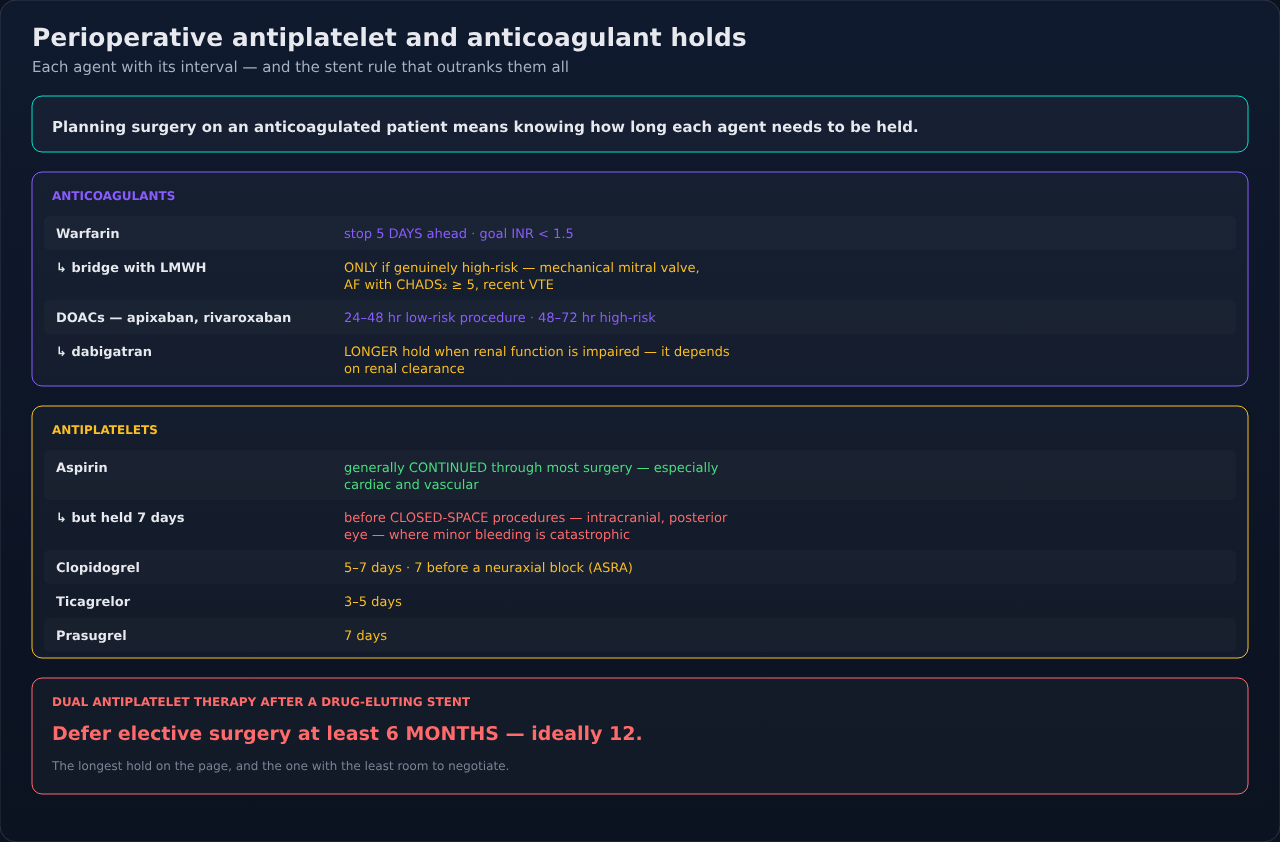
Onset minutes. Half-life ~2.5 h → platelet function recovers 4–8 h after stopping. Renally cleared.
Side effects
- !Bleeding
- !Thrombocytopenia
- !Renal accumulation
Contraindications
- ×Active bleeding
- ×Severe renal impairment/dialysis
- ×Thrombocytopenia
Clinical pearls
- ★ASRA neuraxial: hold 4–8 h (platelet function recovers) before neuraxial procedure.
- ★Reversible + short-acting — platelet transfusion is LESS effective than for abciximab; time is the reversal.
Other drugs in Antiplatelets
- Aspirin
Irreversibly acetylates COX-1 → blocks thromboxane A2 for the platelet's lifespan (~7–10 days). Antiplatelet effect at low dose; analgesic/anti-inflammatory at high dose.
- Clopidogrel
Prodrug → active metabolite (CYP2C19) irreversibly blocks the platelet P2Y12 ADP receptor for the platelet lifespan.
- Prasugrel
Prodrug → active metabolite irreversibly blocks P2Y12. More potent + more consistent than clopidogrel (not CYP2C19-limited), but more bleeding.
- Ticagrelor
Directly and REVERSIBLY inhibits P2Y12 (not a prodrug, not thienopyridine). Faster onset/offset than clopidogrel.
- Ticlopidine
Irreversibly blocks P2Y12. Largely replaced by clopidogrel due to hematologic toxicity.
- Abciximab
Fab fragment that irreversibly blocks the platelet GP IIb/IIIa receptor → prevents fibrinogen cross-linking (final common pathway of aggregation).
- Dipyridamole
Inhibits platelet PDE (↑ cAMP) and adenosine reuptake (↑ adenosine → vasodilation). Weak antiplatelet; also a coronary vasodilator used in stress testing.
- Cilostazol
Inhibits PDE3 → ↑ cAMP → antiplatelet + arterial vasodilation. Improves claudication walking distance.
Browse all classes: /reference/drugs
Suggested reading
- •Miller's Anesthesia, 9e
- •FDA package insert
- •ASRA regional anesthesia in the anticoagulated patient guidelines, 2018