Unintended Intraoperative Awareness
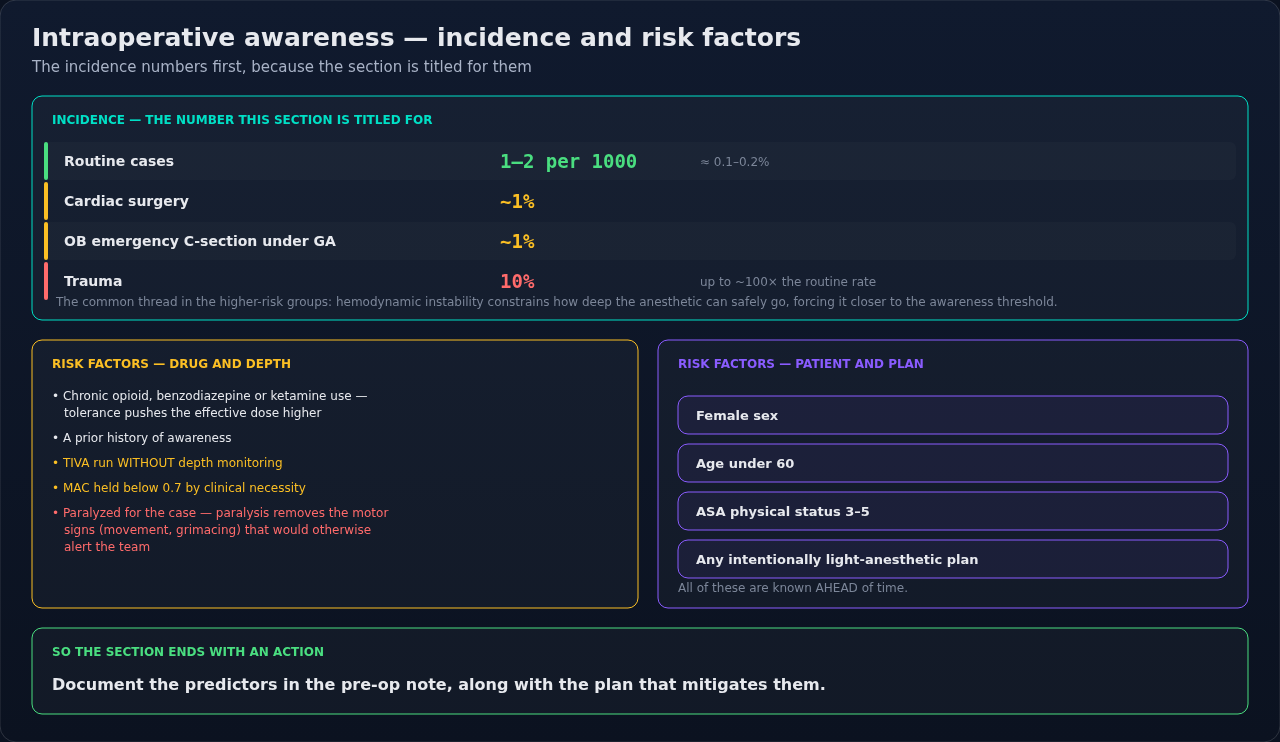
Patient consciousness during surgery, with explicit recall after. Highest-risk groups: cardiac surgery, OB GA, trauma, NMBA paralysis with light anesthetic.
⚡ Rehearsal mode
Walk the algorithm step by step
6 steps · click-through one at a time. Forces you to pre-read each action before moving on — the way you should rehearse the real thing.
Recognition
- •Intraoperative: tachycardia, hypertension, lacrimation, sweating with NMBA-blocked patient
- •Postoperatively: patient reports pain, voices, sensation during surgery (Brice questionnaire)
- •BIS > 60 in maintenance = increased risk; BIS < 40 + age-MAC > 0.7 protective
Steps
- 1Acknowledge + apologize without blameEmpathic listening; do NOT minimize or argue.
- 2Document — what they remember, when, distress level
- 3Refer to mental health — PTSD risk > 50% if untreated
- 4Anesthesia QI/peer review of the caseMost common cause: low-dose maintenance during NMBA.
- 5Disclosure to risk management + patient safety
- 6Future anesthetic plan: depth monitor, written record, consultation note
Drugs + doses
| Drug | Dose | Note |
|---|---|---|
| Anxiolysis if revisiting OR | Midazolam 2 mg IV pre-op |
Pitfalls
- !Don't argue with the patient. Acceptance reduces PTSD severity.
- !BIS is not foolproof; use end-tidal MAC + clinical signs together.
- !OB GA: avoid prolonged thiopental wash-out before delivery if MAC < 0.7.
Suggested reading
- AANA Position Statement: Awareness
- ASA Practice Advisory 2006/2024
- B-Aware Trial
Other crisis algorithms
- Malignant Hyperthermia (MH)
Hypermetabolic crisis triggered by volatile anesthetics or succinylcholine in genetically susceptible patients (RYR1, CACNA1S). Treat with dantrolene immediately.
- Perioperative Anaphylaxis
IgE-mediated (or pseudo-allergic) hemodynamic collapse from drug, latex, or transfusion exposure. Most common triggers in OR: NMBAs (rocuronium, succinylcholine), antibiotics, latex.
- Amniotic Fluid Embolism (AFE)
Rare, often fatal obstetric emergency — anaphylactoid syndrome of pregnancy. Sudden hemodynamic collapse, hypoxemia, and DIC during labor, delivery, or postpartum (within 30 min).
- LAST (Local Anesthetic Systemic Toxicity)
Cardiovascular and CNS toxicity from inadvertent IV injection or systemic absorption of local anesthetic. Bupivacaine highest cardiotoxicity. Ropivacaine + lidocaine slightly safer.
- Laryngospasm
Reflex closure of the vocal cords from light-anesthesia airway stimulation. Common in pediatrics, recent URI, and emergence. Untreated → hypoxia → bradycardia → arrest.
- High / Total Spinal
Cephalad spread of neuraxial local anesthetic causing apnea + cardiovascular collapse. Most common with epidural-to-subarachnoid migration in OB.