OR Fire
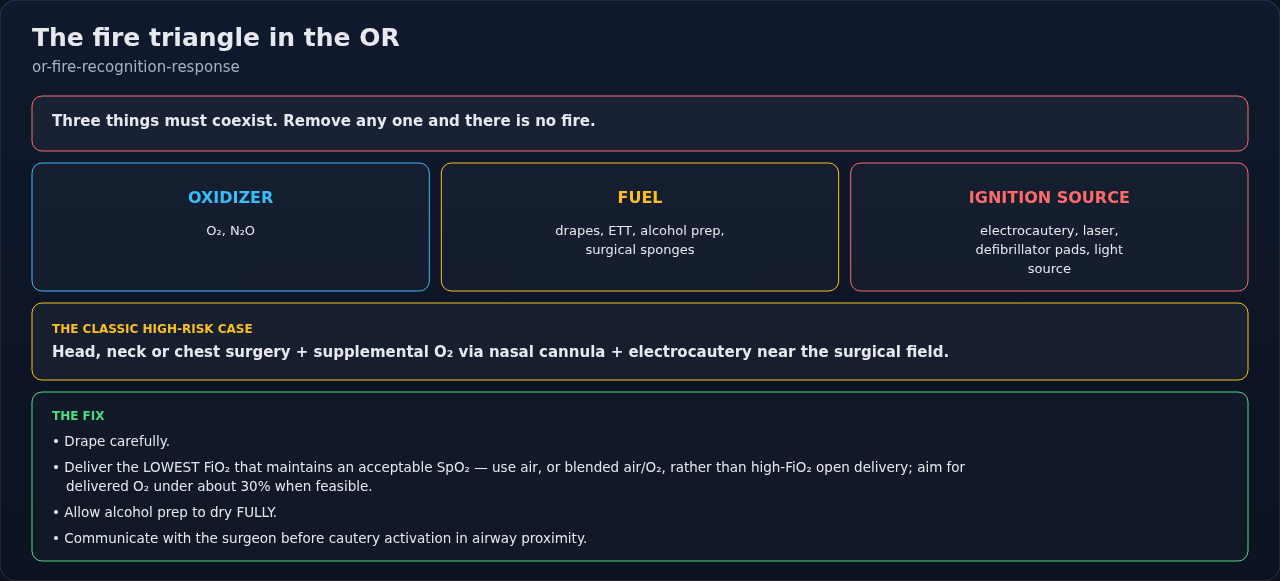
Three-element fire: oxidizer (O₂/N₂O) + fuel (drape, ETT, sponge, hair) + ignition (ESU, laser, fiberoptic). Greatest risk: head/neck surgery with open O₂.
⚡ Rehearsal mode
Walk the algorithm step by step
6 steps · click-through one at a time. Forces you to pre-read each action before moving on — the way you should rehearse the real thing.
Recognition
- •Visible flame, smoke, flash, audible pop
- •Burnt-hair smell during ESU near drapes/airway
- •ETT fire: pop + smoke from circuit, sudden ↑PIP
Steps
- 1Stop the gas — disconnect circuit / stop O₂ + N₂O
- 2Remove burning material — ETT, drapes, spongePour saline; do not use water-based extinguisher near electronics until depowered.
- 3Pour saline on patient + airwayIf ETT fire, remove ETT, ventilate by mask after smoke clears.
- 4Re-intubate via direct laryngoscopyInspect for thermal injury, soot, mucosal burn.
- 5Bronchoscopy + ICU + steroids/antibiotics for inhalation injury
- 6Do NOT use FiO₂ > 30% for ESU near airway in future cases
Drugs + doses
| Drug | Dose | Note |
|---|---|---|
| Methylprednisolone | 1–2 mg/kg IV (controversial for inhalation) | |
| Albuterol | 2.5 mg nebulized for bronchospasm |
Pitfalls
- !Open O₂ via nasal cannula + ESU on the face = fire setup. Use ≤30% FiO₂.
- !ETT cuff fire — even momentary — needs full airway evaluation.
- !Halogenated drapes burn hot; use flame-retardant drapes only.
Suggested reading
- ASA Practice Advisory: Operating Room Fires 2013
- AANA Position Statement
Other crisis algorithms
- Malignant Hyperthermia (MH)
Hypermetabolic crisis triggered by volatile anesthetics or succinylcholine in genetically susceptible patients (RYR1, CACNA1S). Treat with dantrolene immediately.
- Perioperative Anaphylaxis
IgE-mediated (or pseudo-allergic) hemodynamic collapse from drug, latex, or transfusion exposure. Most common triggers in OR: NMBAs (rocuronium, succinylcholine), antibiotics, latex.
- Amniotic Fluid Embolism (AFE)
Rare, often fatal obstetric emergency — anaphylactoid syndrome of pregnancy. Sudden hemodynamic collapse, hypoxemia, and DIC during labor, delivery, or postpartum (within 30 min).
- LAST (Local Anesthetic Systemic Toxicity)
Cardiovascular and CNS toxicity from inadvertent IV injection or systemic absorption of local anesthetic. Bupivacaine highest cardiotoxicity. Ropivacaine + lidocaine slightly safer.
- Laryngospasm
Reflex closure of the vocal cords from light-anesthesia airway stimulation. Common in pediatrics, recent URI, and emergence. Untreated → hypoxia → bradycardia → arrest.
- High / Total Spinal
Cephalad spread of neuraxial local anesthetic causing apnea + cardiovascular collapse. Most common with epidural-to-subarachnoid migration in OB.